2026 NC School of Banking
Appalachian State University - Plemmons Student Union
263 Locust StreetBoone, NC 28608
United States
* Registration open until 7/17/26 at 12:00 AM (EDT)
2026 NC School of Banking
Monday, July 20, 2026 to Friday, July 24, 2026
Appalachian State University - Plemmons Student Union
263 Locust Street Boone, NC 28608 United States
Registration open until 6/30/26 at 12:00 AM (EDT)
Welcome to the 90th Annual North Carolina School of Banking!
The North Carolina School of Banking is dedicated to expanding the skills and abilities of middle managers and prospective managers through lectures, teamwork and hands-on experiences. Bankers who enroll in the School spend a week each summer receiving training in an academic setting.
IMPORTANT INFORMATION FOR REGISTRATION:
We are using a new system and it might look a little different. You can register as a "guest" but you may not have payment options aside from credit card.
It's best to create an account (in this new system) by clicking "Join" at the top. Follow THESE INSTRUCTIONS to help with creating/updating an account.
For invoicing - When selecting "Billable Party" in the invoicing section be sure to select YOURSELF as the billable party or the invoice will go to your company's main contact, which in most cases is your CEO.
Registration Information
Tuition for the School of Banking Includes:
-
Instruction by top faculty and visiting instructors from across the Southeast
-
Hotel rooms booked exclusively for School of Banking students in Boone, North Carolina with collaborative and beautiful networking spaces for students to mix-and-mingle.
-
Coffee service will be provided in the hotel lobbies each morning to ensure a smooth start to your day.
-
Elite shuttle transportation from the hotels to App State for students with Air Haven Limousine service each day.
-
All materials, pre-coursework and coursework provided.
-
Breakfast provided Tuesday through Friday and lunch provided Tuesday through Thursday.
-
Dinner at the school social on Monday.
- Freshman dinner on Tuesday is included in tuition.
School of Banking Tuition Fees
Flat Rate: $2,300
-
Your tuition must be paid in full in order to receive any pre-coursework materials and a hotel room reservation.
-
Deadline to register for School of Banking will be June 30, 2026 to allow ample time to prepare materials for all students.
-
Please be aware that your tuition is non-refundable after May 11, 2026.
-
Please note that this tuition does cover hotel accommodations. If you plan to have accommodation elsewhere or have any hotel accommodation requests or questions , please reach to laura@ncbankers.org).
- Sunday night hotel accommodations are not covered in tuition.
Curriculum
Freshmen year provides instruction in accounting, sales, lending, financial management, marketing, compliance, cyber security, leadership and other banking related topics. Read below for details on each course.
Banking 101
Banking 101 is a course that helps students understand the function of the dual banking system, as well as the supervision process for state-chartered financial institutions. In this course, students will learn the regulatory structure for banks and why banks are so heavily regulated. Banking 101 also covers off-site examination tools, types of regulatory exams, the frequency and processes of risk-focused examinations, and the CAMELS rating system.
Becoming a Resource Manager Through the 5 Cs
Consultative selling is dead and solution selling is in the rear-view mirror; in commercial banking today, those old playbooks no longer play. Entrepreneurs are more demanding than ever before, and they have unending financial services options. How can your bank win these customers over and build partnerships that last years, even a lifetime? A new approach, trust-based selling, has emerged that is working at banks of all sizes. This fast-paced session outlines what it takes to build trust through a new concept – the resource manager. Practical tools and takeaways enable your bank to cultivate client relationships at this next level of excellence.
Compliance Management
Regulatory compliance is the strong infrastructure you must build to strengthen and support your financial institution. It is critical that your organization maintain a culture of compliance to manage the risk inherent in banking and specific to your strategic lines of business. Learn about fair lending, UDAAP, privacy, Bank Secrecy Act and anti-money laundering, Office of Foreign Assets Control, Servicemember Civil Relief Act, Military Lending Act and so many more compliance requirements! We'll make sure you understand the big picture and how to effectively mitigate the ever-increasing risk associated with non-compliance.
Cybersecurity
This course will give students an overview of the risk associated with technology and the importance of understanding this risk for operational and management purposes.
Essentials of Lending
Essentials of Lending is an overview of credit risk management fundamentals for consumer and commercial lending decision-making and portfolio management. We will also take a look at the impact of current changes in the economic environment, customer evolution, regulatory perspectives, as well as information and underwriting tool development. Students will also look at strategies on how to balance the bank’s risk profile with loan growth and profitability.
Key Principles of Effective Leadership
In this short introduction to leadership, the group will identify and discuss the key characteristics to be a successful leader. Starting with the golden circle, participants will uncover their “why” in order to develop the foundation of their own leadership blueprint. Understanding our personal leadership blueprint will help us to effectively lead and influence others.
- Characteristics of positive and negative leaders from their past
- Discuss and agree on the traits of effective leaders
- Explore personal values and identify their top five values
- Discuss the golden circle: why, how, and what. Start with "why" to identify their core value.
- Using values and beliefs to lead and influence others.
Money & Banking
This course aims to provide the student with an introduction to the role of money, commercial bank operations, and how the Central Bank attempts to control and/or influence monetary policy in the economy. The purpose of this course is to provide a broad understanding of economics, the structure of commercial banks and factors impacting operations, monetary and fiscal policy, the bond market, and the impact of governmental intervention via monetary policy within the United States economy.
Principles of Marketing
The Principles of Marketing course introduces the many aspects of marketing and its role in the financial institution. During this course, you will explore the role of bank marketing and its impact within your organization. You will examine marketing's basic fundamentals, as well as study real-world examples of marketing at work within a financial institution.
The Accounting System and Financial Statement Preparation
The freshman year financial management module is comprehensive in that it takes the banker from a basic understanding of the accounting system all the way through an analysis of the financial statements generated by the system, and then emphasizes the use of the financial information internally. Three integrated sessions are utilized to accomplish these
Sophomore Curriculum
Sophomore year focuses on government relations, finance, managerial accounting, crisis communication, conflict management, motivation and delegation and leadership. See
below for details on each course.
Banking Ethics
The goal of this course is to provide students with a practical framework for identifying and addressing ethical situations within a banking organization. We will begin with a discussion of ethics in general and then walk through a set of analytical tools. Students will then have an opportunity to put these tools to use through group discussion of practical ethical situations based on real-world examples.
Bank Performance and Valuation
The influences on valuation in the banking space are constantly changing. This session will focus on the fundamental drivers of valuation and the key performance measures investors use when assessing value. Special attention will be paid to those attributes that management can control, and how perceptions play a role in how an institution is valued.
CAMELS Case Study
During this very interactive session, participants will have an opportunity to assess CAMELS component areas and assign ratings using a report of examination. The class will be divided into small groups so that each group can work directly with a risk management examiner and take a deeper dive into one of the CAMELS areas. Participants will also work in small groups to determine appropriate enforcement actions and propose solutions to the issues they identify.
Conflict Management
Managing conflict is an essential and ubiquitous part of leadership. In fact, given the current business trends toward workforce diversity, globalization, and joint ventures, how managers from different roles and cultures deal with conflict is an increasingly important predictor of organizational success. In this topic, leaders will assess how they manage conflict, what guidelines to use, and when to use each conflict management strategy.
Finance II
This course will provide an overview of corporate financial planning tools, including the evaluation of firm performance, projection of key financial statements, and a discussion of financing policies. The course includes hands-on work and a case study.
Maximizing Your Leadership
Using your personal style awareness to build more effective relationships, self-awareness is the cornerstone of effective leadership. Understanding your preferred behavioral tendencies and how they impact other’s perception of you is key to be the best leader you can. In this session, you’ll receive feedback on your responses to two brief online surveys that will be sent out to you the week prior.
Motivation and Delegation
We cannot achieve success alone. Leaders need employees to perform at high levels consistently. While intelligence is important, having motivation is equally, if not more important. In this session, students will understand key motivation concepts and begin to learn how to apply them and use delegation as a key development tool to motivate employees.
UBPR/CAMELS Overview
This session walks through the Uniform Bank Performance Report (UBPR) for the CAMELS case study to help participants analyze the case study materials, and ultimately to evaluate their own bank’s UBPR. The session also includes a brief overview of regulatory examinations and introduction to the CAMELS case study.
Junior Curriculum
Junior year is designed to provide rising middle managers with senior management perspective. Participants work in small teams to manage a bank through a two-year period using a sophisticated computer simulation program involving asset/liability, capital allocation, investment, business development, lending and human resources management decisions.
Asset/Liability Management I
Dr. Davis starts this session by defining interest rate risk. He shows the class how to measure it and strategies that a bank might use to change it. Dr. Davis will speak on the embedded options that exist in a bank’s balance sheet, and how a bank must deal with them. Finally, he analyzes the various strategies a bank might use to reduce interest rate risk.
Asset/Liability Management II
Dr. Davis will build upon the lesson learned in the first session.
Bank Executive Simulation
BankExec is the industry’s most powerful teaching tool for developing the banking expertise of newly hired managers and expanding the skills of experienced bankers. This widely-used educational tool simulates the activities of a mid-sized commercial bank with exercises in asset/liability management, capital formation and dividend policy, gap analysis, accounting and tax planning, marketing and resource allocation, forecasting and planning economics, pricing bank services, strategic analysis, policy formation and forecasting, organizational structure, and much more. Working in teams, students manage a computer-simulated commercial bank. They analyze then respond to changing banking and economic conditions to see the effects of their decisions on situations that closely parallel today’s banking industry. These sessions are led by experienced executive-level regulators and bank officers, who help provide a real-world perspective to the simulation.
Enterprise Risk Management
This course will provide an overview of the concept of Enterprise Risk Management (“ERM”) as it applies to community banks, and will assist students in a better understanding of the basics of a sound ERM process. The course will include a discussion of best practices, overall governance of the ERM program, and regulatory expectations with regard to ERM. The session will also describe the major individual risk areas that most community banks face and discuss various methods and tools that the management team can use to communicate the bank’s risk profile to directors, examiners, and auditors.
Investments
The class will start by covering why an investment portfolio is needed at any financial institution. The instructor will discuss the size a portfolio should be, and the investments that might be made by a portfolio manager. The instructor will also discuss policy limitations that govern a portfolio, and what kind of reporting should be maintained and distributed to different stakeholders. Finally, a discussion of total return methodology will be discussed.
An Introduction to Situational Leadership
The most effective leaders seek to understand their followers and match the needs of the follower to the leadership style they each need in order to be successful. Not everyone is on the same intellectual, maturity, compliance, or motivational level. Different people are motivated by different things, and this must be considered if one is to be a great leader. When followers receive the leadership they need, when they need it, their performance accelerates, work passion increases, and your organization thrives. Using the principles of Situational Leadership participants will explore the four levels of leadership, when and how to use each style.
- Telling
- Using principles of effective communication such as "I" statements to convey the message and build confidence
- Selling
- Using influence tactics and diffusing resistance to encourage others to buy into the message and actions required
- Participating
- Coaching tools to encourage growth and ownership, leading to higher confidence
- Delegating
- Discuss the benefits and pitfalls of delegation
Senior Curriculum
Senior year is designed to provide rising middle managers with senior management perspective. Participants work in small teams to manage a bank through a two-year period using a sophisticated computer simulation program involving asset/liability, capital allocation, investment, business development, lending and human resources management decisions.
Bank Executive Simulation
BankExec is the industry’s most powerful teaching tool for developing the banking expertise of newly hired managers and expanding the skills of experienced bankers. This widely-used educational tool simulates the activities of a mid-sized commercial bank with exercises in asset/liability management, capital formation and dividend policy, gap analysis, accounting and tax planning, marketing and resource allocation, forecasting and planning economics, pricing bank services, strategic analysis, policy formation and forecasting, organizational structure, and much more. Working in teams, students manage a computer-simulated commercial bank. They analyze then respond to changing banking and economic conditions to see the effects of their decisions on situations that closely parallel today’s banking industry. These sessions are led by experienced executive-level regulators and bank officers, who help provide a real-world perspective to the simulation.
Banking, Public Policy & Advocacy
Remember Schoolhouse Rock and I’m Just a Bill? In this class, NCBA President & CEO Peter Gwaltney will go beyond how a bill becomes law and will delve into the current state of politics in Washington D.C. and how it affects the business of banking at a practical level. The recent elections had a dramatic impact on the balance of power in the administrative and legislative branches of our government, and all of the federal regulatory agencies have new leadership. What does all of this mean for banking today and in the future? Banking is a heavily regulated industry. As such, it is important for bankers to be engaged in advocacy to influence public policy. Students will learn how to get involved in advocacy efforts on behalf of the banking industry.
Bank Performance and Valuation
The influences on valuation in the banking space are constantly changing. This session will focus on the fundamental drivers of valuation and the key performance measures investors use when assessing value. Special attention will be paid to those attributes that management can control and how perceptions play a role in how an institution is valued.
Economic Update
In this session, Dr. Davis will look at the present situation with the national and state economies. He will pay particular attention to consumer spending, wage and salary growth, employment, and housing. Dr. Davis will also discuss the relationship between economic growth and bank performance. Finally, he will speak on economic policy and the outlook for the economy.
Strategic Planning
During this session, students will discuss the importance of developing, implementing, and sustaining banking strategies to help differentiate their financial institution from the competition. Discussion includes pulling from bank and non-bank case studies and applying the information to our current competitive landscape.
FAQ
HOUSING
- Hotel Arrival and Bag Drop is from 11:00 am - 12:00 pm.
- All students will be housed in hotels located close to the ASU campus.
- Freshmen and Sophomores will be housed at the Graystone Lodge, and Juniors and Seniors will be at the Marriott Courtyard.
- Coffee service will be provided in the hotel lobbies each morning.
TRANSPORTATION
Because our housing will be off campus, we have contracted with Air Haven Limousine to provide convenient shuttle service between our two hotels and the Plemmons Student Union Building (our classroom building).
WHAT TO PACK
For class
- Your favorite re-usable water bottle / coffee mug
- To best prepare for your time at App State as a visiting student with us, please read about APP State's Sustainability Initiatives here . Bring your favorite re-usable water bottle and fill it up around the Plemmons Student Union!
- Umbrella ** highly encouraged due to summer storms**
- Rain jacket
- Laptop / tablet / iPad and the charger.
- Backpack/bag to carry your materials to and from class
- Notebook/pens if you are prefer to take notes by hand
- Phone charger/phone charging bank.
Clothing
We want you to be comfortable while you’re in class.
- Casual clothes (khakis, t-shirts, polos, casual tops, shorts, pants, sundresses, jeans, tennis shoes, sandals) will be appropriate for the classroom sessions. Please note, a light sweater or jacket is highly encouraged due to varying temperatures in the classrooms.
- Please consider layering to maximize your options for class comfort. (Example. Consider a t-shirt under a light cardigan or sweater).
- To maximize your preparedness, plan on packing moisture wicking fabrics as students will be in class/simulations for a considerable amount of time.
- Consider bringing another set of comfortable clothes in your bookbag before you leave the hotel for class for even more options in comfort.
- Boone is very hilly. Comfortable shoes are recommended. Heels are highly discouraged.
- Seniors will need to dress in business causal attire for their BankExec presentations and graduation on Friday. Coat/ tie are preferred for men. Dresses or nice pants are recommended for women. All other classes can remain casual for graduation.
LOCATIONS
- Opening Convocation: Parkway Ballroom at Plemmons Student Union
- All Classes: Plemmons Student Union
- Breakfast Tuesday - Friday: Central Dining Hall
- Lunch Tuesday - Thursday: Central Dining Hall
- Dinner on Monday at the School Social: Kidd Brewer Stadium
|
DEAN: Dr. Harry Davis |
PROVOST: Bill Cable |
David Beaver |
|
Katie Bosken |
Dr. Justin Cox, Ph.D. |
Steve Crouse |
|
Dan Ellis |
Jonathan Kilberg |
Stacy Reedy |









Hotel Accommodations for NCSB Students
Students attending the North Carolina School of Banking have the option to stay at one of two conveniently located hotels near the Appalachian State University campus. Both hotels offer comfortable accommodations and easy access to the school’s sessions, ensuring a seamless experience throughout the week. Each student will enjoy the comfort and privacy of their own individual hotel room.
For questions regarding accommodations, please contact laura@ncbankers.org.
Freshmen and Sophomore Lodging: Graystone Lodge
Nestled in the heart of the Blue Ridge Mountains, Graystone Lodge offers a perfect blend of relaxing comfort and modern design. Just minutes from downtown Boone, this location is ideal for those looking to explore the beauty and adventure that North Carolina’s High Country has to offer.
If you plan to arrive one night early on Sunday, 7/19 or extend your stay past Friday 7/24, please book your room here . Students are responsible for the cost for any additional nights outside of 7/20-7/24.
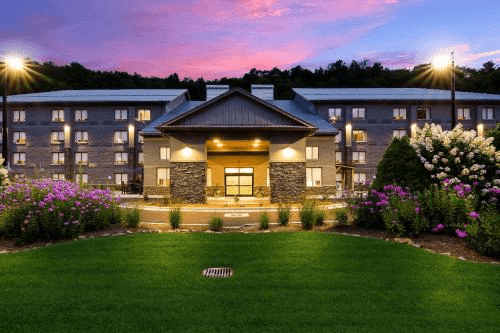
Graystone Lodge Amenities:
- High Country Breakfast: Start your day with a hearty breakfast featuring local specialties.
- Local Hatchet Coffee: Enjoy freshly brewed coffee from one of Boone’s favorite local roasters.
- Indoor Pool: Take a dip in our heated indoor pool, perfect for year-round relaxation.
- Outdoor Fire Pit: Gather around the fire pit in the evening to unwind and enjoy the mountain air.
- Fitness Center: Keep up with your workout routine in our fully equipped fitness center.
- Outdoor Seating Area: Relax in our outdoor seating area where you can enjoy the fresh mountain air.
- Local Artwork: Local artwork and images of scenic views are located throughout the hotel..
- EV Chargers: Convenient electric vehicle chargers are available for our eco-conscious guests.
- Grassy Pet Area: We love pets! Our grassy pet area ensures your furry friends are comfortable too.
Junior and Senior Lodging: Courtyard Marriott Boone
Courtyard Boone is located in the beautiful NC mountains. Whether traveling for business or fun, Courtyard by Marriott® is centrally located in the heart of Boone. Courtyard of Boone is just moments from Appalachian State University, superb shopping and dining.
If you plan to arrive one night early on Sunday, 7/19 please book your room here . Students are responsible for the cost for any additional nights outside of 7/20-7/24.
If you plan to stay past Friday, 7/24 you can book additional nights here .
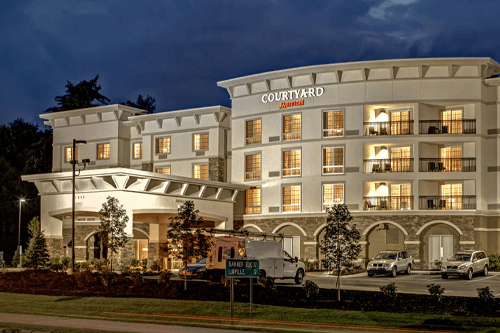
Courtyard Marriott Amenities:
The new state-of-the-art lobby at Courtyard provides greater flexibility and choices for guests. You'll also enjoy flexible spaces to work or relax, with free Wi-Fi throughout. A well-equipped fitness center and indoor pool will help you stay energized. Amenities include:
- Sustainability
- Free Wifi
- Restaurant
- Indoor Pool
- Fitness Center
- Meeting Space
- Convenience Store
- Dry Cleaning Service
- Laundry
- Wake up Calls
- Kitchenette
- Mobile Key
- Digital Check In
- Service Request
Restaurants and Downtown Dining
Looking for a bite to eat after class? Any App State student will tell you that the action is off-campus. The following dining options are all within a 1 mile hike:
- Sticky Boy Bread Co
- Dan'l Boone Inn Restaurant
- Local Lion
- Elevation 3333
- Troy's 105 Diner
- Wild Craft
- Melanie's Food Fantasy
- The Local
- Lost Province Brewing Co
- Casa Rustica
- Boonshine Brewing Company